Street-Legal LSV vs Golf Cart in North Carolina — A Clear Guide from Carts of the Carolinas
A standard golf cart is perfect for neighborhood cruising and private community use.
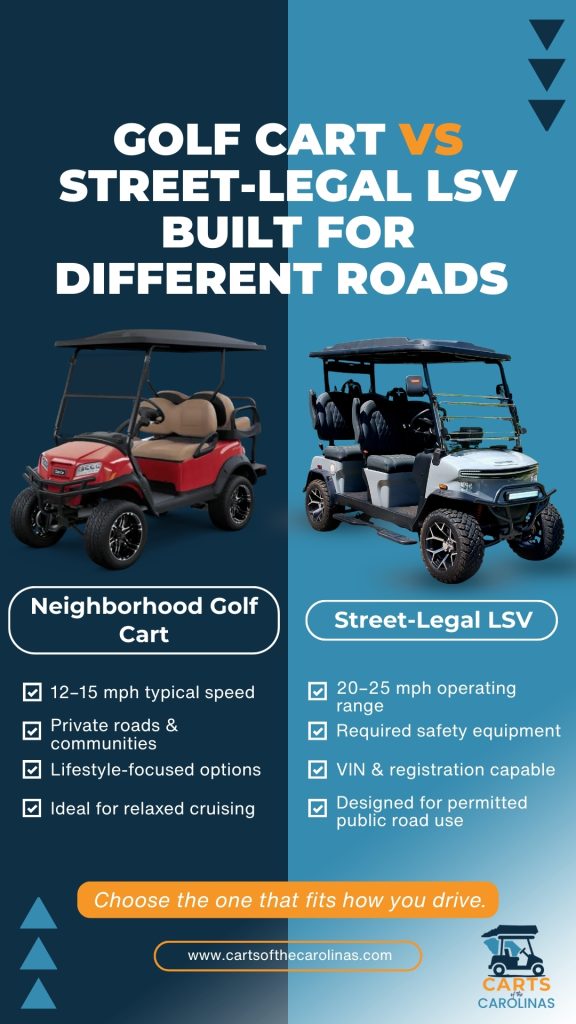
A street-legal Low-Speed Vehicle (LSV) is built with specific safety features, a VIN, and the ability to travel 20–25 mph for limited road use where local laws allow.
The key isn’t which one is “better.”
It’s which one fits how you actually plan to drive.
At Carts of the Carolinas, we help you make that decision with clarity and confidence.
Why “Street Legal” Can Feel Confusing
If you’ve been researching online, you’ve probably noticed something:
Everyone seems to define “street legal” a little differently.
Some carts have lights.
Some have seat belts.
Some look ready for the road.
But not every cart qualifies as a true Low-Speed Vehicle.
That’s where buyers start second-guessing themselves.
We hear it every week in our Youngsville showroom: “I just want to make sure I’m choosing the right thing.”
That’s exactly the right approach — and we’re here to help you feel confident about it.
What “Street-Legal” Actually Means in North Carolina
In North Carolina, a vehicle must meet specific federal and state requirements to qualify as a Low-Speed Vehicle (LSV).
An LSV:
- Is designed to operate between 20–25 mph
- Includes required safety equipment
- Has a 17-digit VIN
- Can be registered and insured
- May be driven on certain public roads where local ordinances allow
A standard golf cart is designed primarily for private property, golf courses, and neighborhood streets that don’t require public-road compliance.
Neither option is “wrong.” They’re simply built for different types of use.
Road use always depends on state law and local ordinances — and we walk through that together before you decide.
Inside a Street-Legal LSV: What Makes It Different?
This is where confidence comes from — understanding the details.
Required Safety Features on an LSV
- DOT-approved headlights
- Brake lights and tail lights
- Turn signals
- Reflectors
- Windshield
- Side and rearview mirrors
- Seat belts for each passenger
- Parking brake
- Horn
- 17-digit VIN
- 20–25 mph speed capability
These features aren’t just upgrades — they’re part of what allows the vehicle to qualify for limited road use.
A standard golf cart may include some similar features, but unless it is manufactured and certified as an LSV, it doesn’t automatically meet the same classification.
Speed, Visibility, and Everyday Use
One of the biggest differences between a standard golf cart and an LSV is how they interact with the road.
Standard golf carts typically operate around 12–15 mph — perfect for neighborhood life, community gatherings, and property use.
LSVs operate in the 20–25 mph range, which allows them to function more comfortably in low-speed traffic environments where permitted.
That added speed comes with built-in safety and visibility considerations designed to support limited roadway use.
If you plan to cross public roads or connect different sections of your neighborhood, this distinction matters.
Spring Break & Summer: Should You Rent Before You Buy?
As the weather warms up across Youngsville and the Triangle, we see a seasonal pattern every year:
- Families hosting Spring Break visitors.
- Grandkids coming for summer.
- Neighborhood cookouts and community events picking up.
- Beach trips and second-home weekends increasing.
Many homeowners start asking: “Should we finally get a cart?”
Here’s something we always say — you don’t have to rush that decision.
Renting Can Make Sense If:
• You’re hosting guests temporarily
• You want to test neighborhood driving patterns
• You’re considering an LSV but aren’t sure about road access
• You need short-term transportation for events
• You want a beach-week cart without long-term ownership
Our rental program allows families to experience the lifestyle before committing to a purchase.
It’s a relaxed, practical way to answer: “How would we actually use this?”
For some customers, renting confirms they want to move forward with a purchase.
For others, it’s the perfect seasonal solution. There’s no wrong answer — just what works for your household.
A Common Scenario: “I’ll Just Upgrade Later”
We completely understand the thought process.
Many buyers assume they can purchase a standard golf cart now and convert it later if needed.
Sometimes that works.
Often, it becomes more complicated than expected.
Choosing the right platform upfront usually provides:
- Clearer registration guidance
- Simpler compliance
- Better long-term value
- Greater peace of mind
That’s why we encourage starting with the question:
Where will you realistically drive most often?
How Carts of the Carolinas Makes This Easy
When you visit our showroom in Youngsville, we don’t start with features.
We start with your lifestyle.
- Are you cruising within a private community?
- Crossing public roads occasionally?
- Transporting grandchildren?
- Hosting neighborhood gatherings?
- Looking for lithium battery reliability and lower maintenance?
From there, we explain:
- What’s required
- What’s optional
- What adds comfort
- What improves visibility
- What truly fits your needs
It’s a relaxed conversation — not a sales pitch.
Proudly Serving Youngsville and the Triangle
We work with homeowners and families throughout:
- Wake Forest
- Raleigh
- North Raleigh
- Durham
- Chapel Hill
- Rolesville
- Franklinton
- Louisburg
- and surrounding Triangle communities.
Delivery is available throughout North Carolina, South Carolina, and Virginia.
Because local ordinances vary, working with a knowledgeable local dealer helps remove uncertainty.
Let Carts of the Carolinas Help You Choose with Confidence
If you’re researching:
- Are golf carts street legal in NC?
- What is a Low-Speed Vehicle?
- Do I need an LSV?
- Golf cart vs LSV differences
Frequently Asked Questions
Are golf carts street legal in North Carolina?
In most cases, standard golf carts are not automatically street legal in North Carolina.
To drive on certain public roads, a vehicle must qualify as a Low-Speed Vehicle (LSV), which means it includes required safety equipment, a 17-digit VIN, registration, and insurance.
Even then, operation is typically limited to roads with posted speed limits of 35 mph or lower, and local ordinances must allow it.
What is the difference between a golf cart and a street-legal LSV?
A standard golf cart is designed for private property, golf courses, and neighborhood use.
A street-legal LSV:
- Operates between 20–25 mph
- Includes required safety features like seat belts, mirrors, lights, and a windshield
- Has a VIN and can be registered
- Is built to meet federal vehicle standards
Can you drive a golf cart on the road in NC?
You generally cannot drive a standard golf cart on public roads unless your local municipality has specific ordinances allowing limited use. A properly classified and registered LSV may be driven on certain roads where permitted. Because rules vary by town and HOA, it’s important to verify before assuming road use is allowed.
How fast does a street-legal golf cart go?
A qualifying Low-Speed Vehicle (LSV) operates in the 20 to 25 mph range.
That speed classification is part of what separates it from a standard golf cart, which typically travels around 12–15 mph.
Do street-legal golf carts require insurance in North Carolina?
Yes. If the vehicle is registered as an LSV for road use, insurance is typically required — similar to other motor vehicles. Requirements can vary, so it’s best to confirm coverage expectations before registering.